

“I’m My Sister’s Favorite Story”
Ah, siblings. Gotta love ‘em. Ok, here’s the first good news, and there’s more to follow: You can absolutely make it stop, and you don’t have to turn it into a big thing.
Let’s get into it.
The Breakdown
There’s a lot to digest here — privacy, familial politics, the concept of engagement parties in general — but there are a few sentences to highlight:
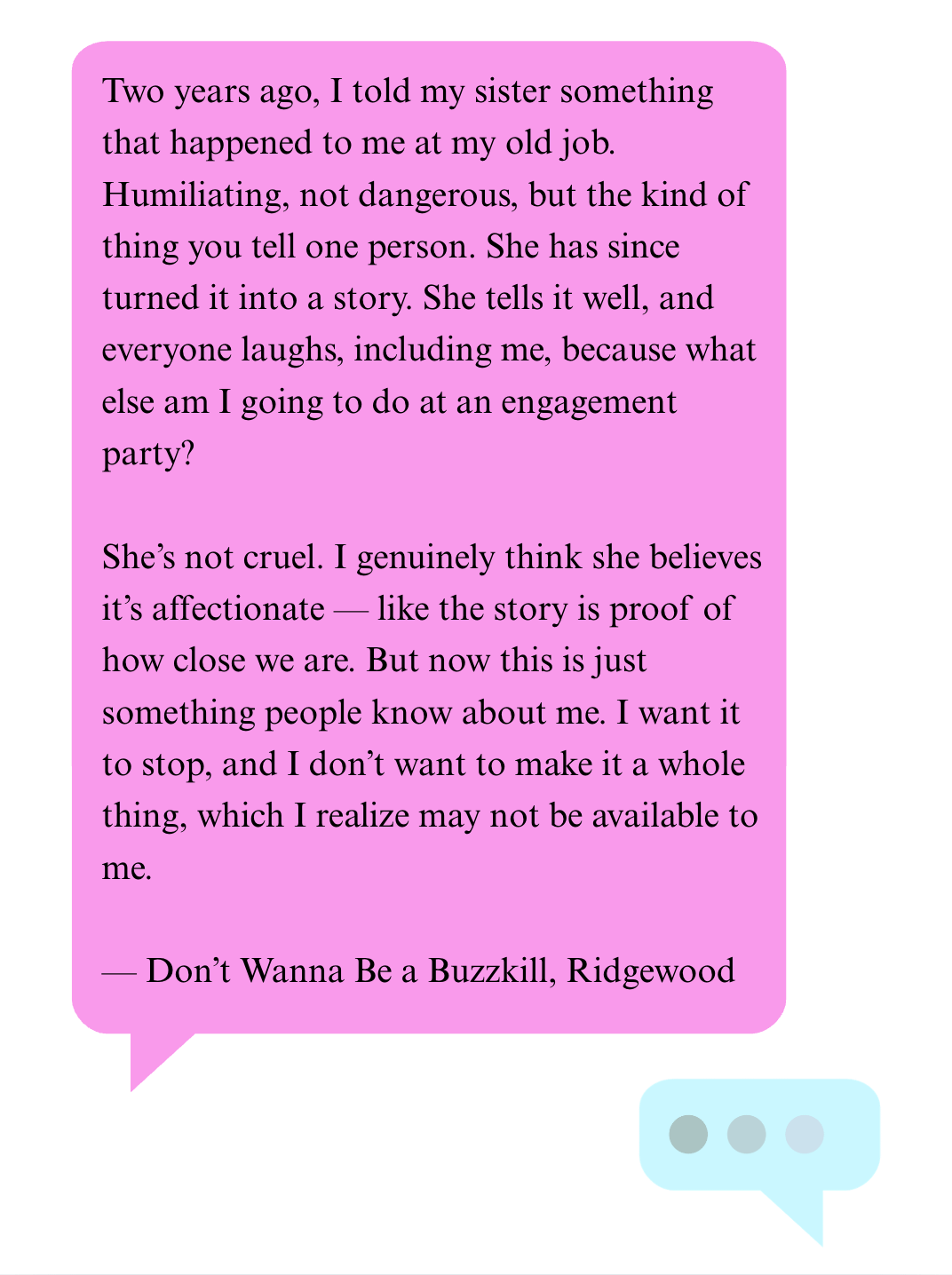
"Humiliating, not dangerous.” Humiliation is a very personal emotion, and we’re all encouraged to hide it. For years, I was mortified that I’d lost my virginity in the back of a car in a church parking lot instead of on the back of a yacht in the Riviera, as I’d imagined. It happens to all of us. Humiliation stems from the social repercussions of doing something foolish. Admission of humiliation can feel like admission of fault. And fault can feel like stupidity, which can feel like weakness. And monkey brain say weakness bad and dangerous. So as much as the story wasn’t dangerous in terms of your safety, the humiliation can sometimes feel just as skin-crawling.
“What else am I going to do at an engagement party?” This is the real hurdle because your sister is constructing a situation in which you don’t know who knows this embarrassing thing about you. She’s telling your story for you to people neither of you have really vetted. So suddenly, the ops are all around you, and you don’t know what they look like, what their values are, who they work with, or — the absolute worst case — if they know your ex. The horror. As a rule, your ex should only ever hear your most flattering rumors. If my ex found out I took a poorly aimed piss in the Dolomites because I couldn’t ski to the lodge fast enough: Hell incarnate. But if my ex found out I was tossed in the air by a dozen men in uniform at the Fiesta Nacional de España: Better than heroin.
“I want it to stop, and I don’t want to make it a whole thing.” Again, super doable so long as your sister isn’t a raging — well, something raging. Omitting a story from your vocabulary is actually really easy. OK, there may be a genuine moment early on where she forgets and slips up, but such things are sometimes unavoidable. Hopefully, she’ll be embarrassed enough to not do it again.
The Script
The single most important part of the conundrum: she believes she’s being affectionate. Moreover, she doesn’t just want to be close to you; she wants others to know she’s close to you.
From the context, it seems like she’s proud to have you in her life. This means she’s telling this story in good faith and doesn't realize you don’t like it. For her, that means this message will probably read like a shock— like when you don’t know you’re standing on someone’s foot in the subway. You have to let her know that she’s stepping on you, especially if she doesn’t realize.
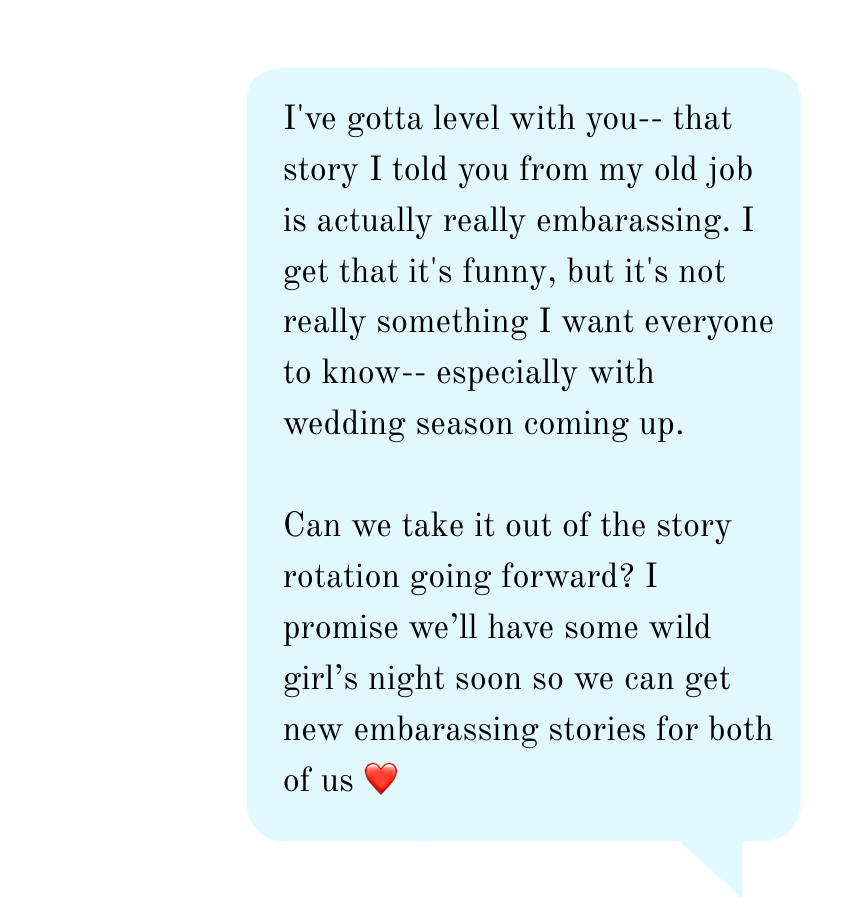
So we’ll open with a classic: “I’ve gotta level with you.” As a scriptwriter, this quickly became a go-to for pretty much every situation. It immediately lets the other person know that you’re entering the conversation with honesty and vulnerability, but it doesn’t leave you with the wishy-washy “I feel” language that can sometimes (not always) leave you without a sturdy foundation for the rest of the conversation. It can also end up sounding more accusatory, as it can imply via context clues that the person you’re texting is causing these feelings. Not the best start in this case.
This layout opens by preparing her for your honesty, admitting a vulnerability, agreeing with her reasoning (important here because if everyone’s laughing, it’s funny. Don’t deny that fact or she’ll just hit you with “But it’s not embarrassing — it’s funny!”). You know it’s funny— but it’s ALSO embarrassing. Acknowledging that fact rejects the premise that you don’t understand why she’s telling the story, which she’d quickly counter, especially with good intentions, to comfort you (or attempt to).
“… especially with wedding season coming up.” Here, you’re giving her a reason this is happening now; otherwise, it could look like you’ve been griping about this for a long time and have reached a sudden, internal breaking point. That makes it weird for everyone because it suddenly raises the stakes dramatically. This is something you’re flagging because you were just reminded of it; it’s not a long-held grudge. When you can bring in an instigating event, do it.
Last, the request. We’re gonna state it clearly but without blaming her. This is one of those annoying places where we’re going to use “we.” Of course, saying “we” instead of “you” is simply inaccurate for this situation. You know that; she’ll know that. But this is not about being accurate— it’s about the way your sister hears this message in her head. The “we” is not practical, it’s a subconscious offer to walk with her through this issue. That allows you to work through it as a team rather than as opposing forces.
This tactic is not applicable in every situation, but it is useful when you’re trying to address a problem without “making it a whole thing.” For a sister with good intentions, this is a great move to employ. And, to be fair, if you haven’t told her just how embarrassing the story is for you, it is kinda your fault too, so the “we” isn’t entirely empty.
An important note: do NOT use this model on anyone who defaults to people being “fake.” An unwarranted “we” can read like an attempt to hide the reality or depth of the issue, and will only make things worse. If that’s the case with your sister, stick to “you.” Bluntness often feels more honest to people who are guarded; just be careful not to be cruel.
Finish it all off with the closer: “I promise we’ll have some wild girls’ night soon and we can get new embarrassing stories for both of us.” As this is your sister, adding some levity to the end is going to do a lot of work in communicating to her that it’s not that deep; you just want her to stop. Even more than that, you’re offering to take her out to make some new embarrassing stories for BOTH of you. This A) shows the sister who obviously loves knowing you that you also love knowing her and want to spend time with her, and B) offers to replace that old story with a better one — and one that she can be a part of. On top of that, it subtly and playfully reminds her that she has embarrassing stories too, so if she’s telling a story you don’t want to be told, she’s setting the precedent for the stories you could tell about her. A threat? Meh. A water-gun to the head of your sibling? Absolutely — but it’s your sibling; a mild threat here and there is perfectly natural.
The Variant
Now, as always, I’m just a girl, and I don’t know you or your sister. If the relationship is more tenuous than the one I just described, there are a couple of ways to make the message more firm.
1. Change the opening to explain the consequences you’ve already experienced.
“Aunt Maggie just asked me how I’m feeling after breaking the office printer while printing out my Loki fanfic for slutty bookclub, and if she brings it up at Thanksgiving, I’m going to pass away.” This addresses the problem as the result of her actions, contextualizing the story sharing as something that has recently affected you in a negative way. And since no one wants their aunt asking them about their hobbies in general, let alone their unwell relationship to Tom Hiddleston, the first thing she’ll understand is “Your actions caused me pain.”
2. Change “I know it’s funny…”
“I’ve been laughing along to it in the moment, but really it’s just hard to admit how embarrassing it is.” So we’ve got “this is why I’ve been laughing” without agreeing that it’s funny. This is largely a change to protect your own feelings rather than to change her reaction. Sometimes, admitting that your embarrassing story really is funny causes more psychic damage than it’s worth.
3. Make it a direct request.
“Can you please stop telling people that story?” No softening. And ending on a yes-or-no question means any text that’s not “Oh, of course I’m so sorry,” can be met with a simple “Sorry — so that’s a no?” That makes her defend her logic since a no to that request is genuinely indefensible. She’ll either come to that realization herself, or you can explain it to her in more detail — if you want.
The Out
We can’t predict exactly how she’ll react, but there are a few likely responses.
The best: “I didn’t realize, I’m sorry! I’ll keep it to myself from now on. Now— girls’ night?”
Easy, you did it. Say “Thank you! How abt Saturday night?”
Mid tier: “But it’s so funny! They’re not laughing at you, they’re just laughing at the situation!”
This is where you give her the simple truth: “It doesn’t really feel like that, even if that is the case. I feel like it’s more private for me, which is why I only told you.” This communicates a lot to you; mainly that other people’s thoughts on this don’t matter more than your own. It gives you the added bonus of highlighting an important fact: You only told her for a reason, probably because you’re close enough to feel safe telling her something you wouldn’t tell anyone else. This will remind her that this is not a story for EVERYONE; it’s a story for HER — which makes it more special.
Worst case: “It’s just a funny story, you shouldn’t be so sensitive.”
Woof, you’ve got a hella of a sister. Time to get blunter: “This is a story I wanted to share with you, not everybody else. If I’d known you were going to go ppublic, I wouldn’t have told you in the first place. If that’s the relationship you want, fine — but I’d really rather tell you about my life without hearing about it from Aunt Maggie.” If she’s really not going to stop, there’s not much you can do except explain that it’s going to change your relationship, and if she’s anything like you described, losing you is the last thing she wants to do.
The All in All
Given that this is your sister and siblings can be little assholes on occasion, she might take a while to “get it,” especially if she opens with our worst-case text. But if she really cares about you, as she seems to, she’ll come around.
